Exploration and Colonization(1400s – 1700s)Created by Ben BindewaldSouthwood Middle School
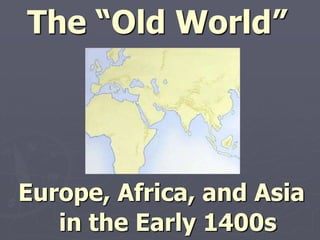
The “Old World”Europe, Africa, and Asia   in the Early 1400s
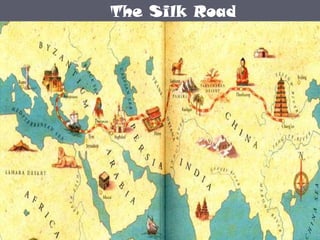
TradeTrade	   -Europeans wanted goods such 	    as spices, silk, and tea from 	 	“the Indies” (Southeast Asia)The Silk Road	   -Ran from Europe to the Indies	   -Was kept safe by strong 		Chinese rulers
The Silk Road
Changes in Trade RoutesNew rulers took over Silk RoadIt became unsafe to travelIncreased taxes made trade very expensiveRise of Ottoman EmpireOttoman rulers became “middle-men” in trade between Europeans and AsiansAsian goods became too expensive for most Europeans to buy
Europeans Explore The World
Why did Europeans want to explore?To find new trade routes to the IndiesWanted to go around the “middle men” and trade directly with merchants in the Indies to get richFor glory and adventureTo spread their cultureChristian religion and European values
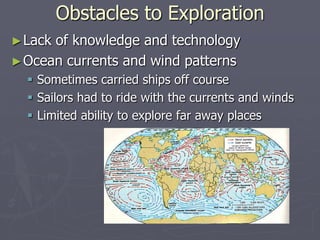
Obstacles to ExplorationLack of knowledge and technologyOcean currents and wind patternsSometimes carried ships off courseSailors had to ride with the currents and windsLimited ability to explore far away places
Europeans began exploringin the late 1400sSharing of ideasMap-makers, shipbuilders, navigators, and inventors shared information that made exploration possibleEuropeans gained access to maps and sailing information from the Chinese, Greeks, and ArabsDevelopment of new technologyBy the late 1400s, Europeans had the technology needed to begin exploring faraway places
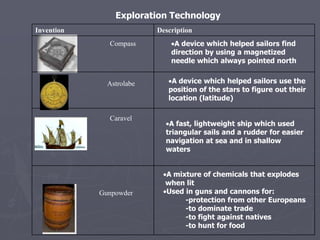
Exploration TechnologyCompassA device which helped sailors find direction by using a magnetized needle which always pointed north
A device which helped sailors use the position of the stars to figure out their location (latitude)AstrolabeCaravelA fast, lightweight ship which used triangular sails and a rudder for easier navigation at sea and in shallow waters
A mixture of chemicals that explodes  when litUsed in guns and cannons for:   -protection from other Europeans   -to dominate trade   -to fight against natives    -to hunt for foodGunpowder
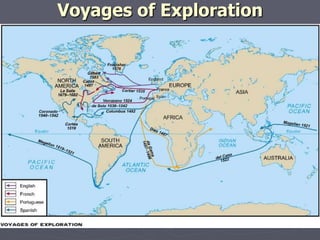
Voyages of Exploration
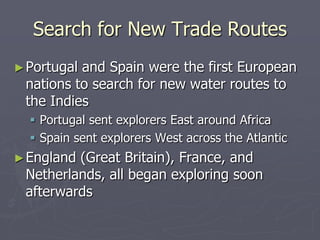
Search for New Trade RoutesPortugal and Spain were the first European nations to search for new water routes to the IndiesPortugal sent explorers East around AfricaSpain sent explorers West across the AtlanticEngland (Great Britain), France, and Netherlands, all began exploring soon afterwards
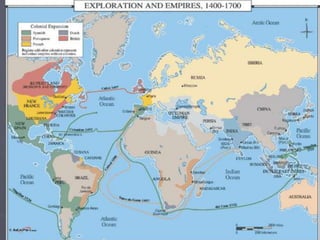
EuropeanColonialism(1500s-1700s)
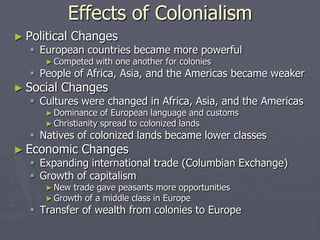
colonialism: a system in which powerful nations rule over the land  and people of weaker nations	-colony: a land and its people that are      controlled by a more powerful nation  -colonial power: a nation which has taken 	control of the government and economy of 	a weaker nation or territory  (a.k.a. mother country)
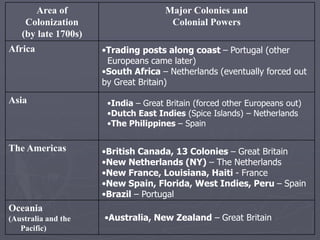
Trading posts along coast – Portugal (other      Europeans came later)South Africa – Netherlands (eventually forced out by Great Britain)
India – Great Britain (forced other Europeans out)
Dutch East Indies (Spice Islands) – Netherlands
The Philippines – Spain
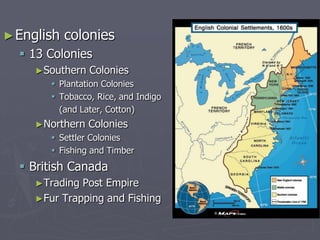
British Canada, 13 Colonies – Great Britain
New Netherlands (NY) – The Netherlands
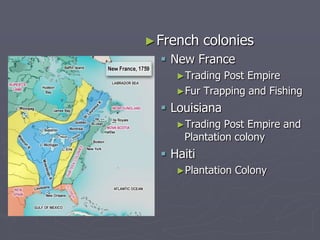
New France, Louisiana, Haiti - France
New Spain, Florida, West Indies, Peru – Spain
Brazil – Portugal
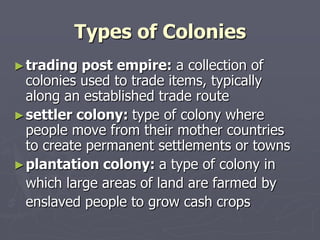
Australia, New Zealand – Great BritainTypes of Coloniestrading post empire: a collection of colonies used to trade items, typically   along an established trade routesettler colony: type of colony where people move from their mother countries   to create permanent settlements or townsplantation colony: a type of colony in 	which large areas of land are farmed by 	enslaved people to grow cash crops
Europeans in Asia
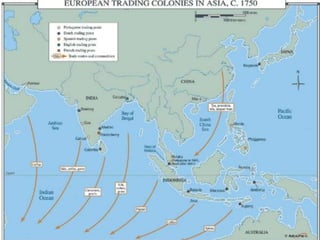
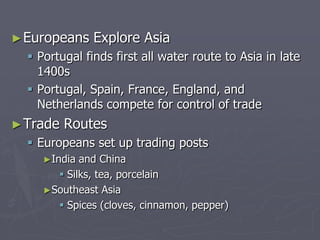
Europeans Explore AsiaPortugal finds first all water route to Asia in late 1400sPortugal, Spain, France, England, and Netherlands compete for control of tradeTrade RoutesEuropeans set up trading postsIndia and ChinaSilks, tea, porcelainSoutheast AsiaSpices (cloves, cinnamon, pepper)
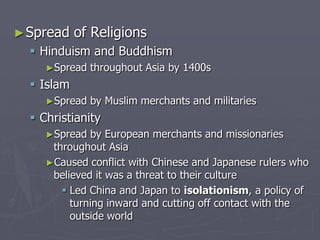
Spread of ReligionsHinduism and BuddhismSpread throughout Asia by 1400sIslamSpread by Muslim merchants and militariesChristianitySpread by European merchants and missionaries throughout AsiaCaused conflict with Chinese and Japanese rulers who believed it was a threat to their cultureLed China and Japan to isolationism, a policy of turning inward and cutting off contact with the outside world
Europeans in the Americas
European Explorers and ConquerorsChristopher Columbus “discovered” the Americas while looking for a western route to the IndiesOther explorers from Spain, Portugal, England, France, and the Netherlands continued to explore the “New World”European nations later began conquering and colonizing the Americas
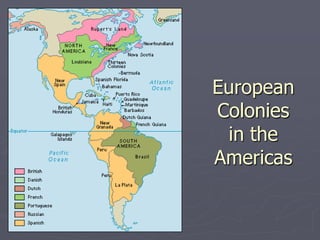
European Colonies in the Americas
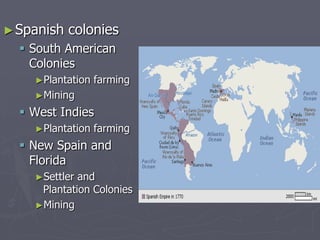
Spanish coloniesSouth American ColoniesPlantation farmingMiningWest IndiesPlantation farmingNew Spain and FloridaSettler and Plantation ColoniesMining
French coloniesNew FranceTrading Post EmpireFur Trapping and FishingLouisianaTrading Post Empire and Plantation colonyHaitiPlantation Colony
English colonies13 ColoniesSouthern ColoniesPlantation ColoniesTobacco, Rice, and Indigo	(and Later, Cotton)Northern ColoniesSettler ColoniesFishing and TimberBritish CanadaTrading Post EmpireFur Trapping and Fishing
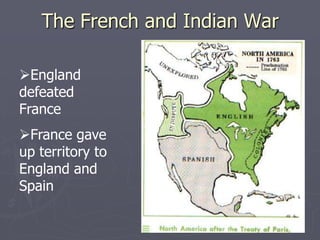
The French and Indian WarEngland  defeated   France
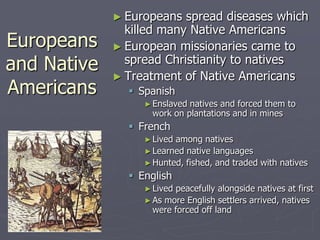
France gave up territory to England and SpainEuropeans spread diseases which killed many Native AmericansEuropean missionaries came to spread Christianity to nativesTreatment of Native AmericansSpanishEnslaved natives and forced them to    work on plantations and in minesFrenchLived among nativesLearned native languagesHunted, fished, and traded with nativesEnglishLived peacefully alongside natives at firstAs more English settlers arrived, natives were forced off landEuropeans and Native Americans
Europeans in Africa
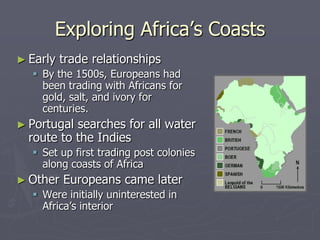
Exploring Africa’s CoastsEarly trade relationshipsBy the 1500s, Europeans had been trading with Africans for gold, salt, and ivory for centuries.Portugal searches for all water route to the IndiesSet up first trading post colonies along coasts of AfricaOther Europeans came laterWere initially uninterested in Africa’s interior
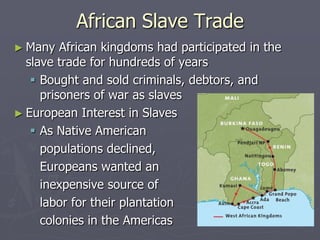
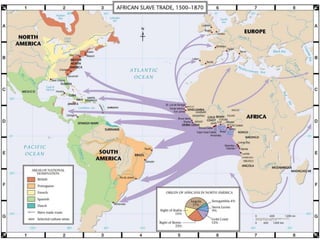
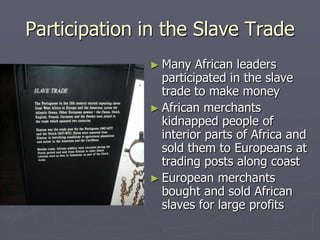
African Slave TradeMany African kingdoms had participated in the slave trade for hundreds of yearsBought and sold criminals, debtors, and prisoners of war as slavesEuropean Interest in SlavesAs Native American 	populations declined, 	Europeans wanted an 	inexpensive source of 	labor for their plantation 	colonies in the Americas
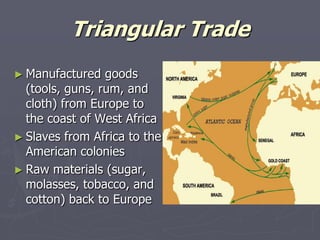
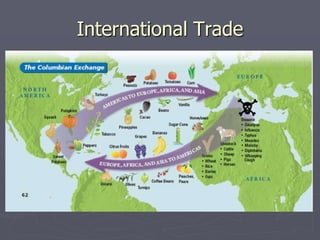
Triangular TradeManufactured goods (tools, guns, rum, and cloth) from Europe to   the coast of West AfricaSlaves from Africa to the American coloniesRaw materials (sugar, molasses, tobacco, and cotton) back to Europe
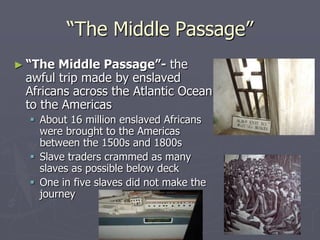
“The Middle Passage”“The Middle Passage”- the awful trip made by enslaved Africans across the Atlantic Ocean to the AmericasAbout 16 million enslaved Africans were brought to the Americas between the 1500s and 1800sSlave traders crammed as many slaves as possible below deckOne in five slaves did not make the journey
7 1.1 exploration and colonization

  • 1.
    Exploration and Colonization(1400s– 1700s)Created by Ben BindewaldSouthwood Middle School
  • 2.
    The “Old World”Europe,Africa, and Asia in the Early 1400s
  • 3.
    TradeTrade -Europeans wanted goods such as spices, silk, and tea from “the Indies” (Southeast Asia)The Silk Road -Ran from Europe to the Indies -Was kept safe by strong Chinese rulers
  • 4.
  • 5.
    Changes in TradeRoutesNew rulers took over Silk RoadIt became unsafe to travelIncreased taxes made trade very expensiveRise of Ottoman EmpireOttoman rulers became “middle-men” in trade between Europeans and AsiansAsian goods became too expensive for most Europeans to buy
  • 6.
  • 7.
    Why did Europeanswant to explore?To find new trade routes to the IndiesWanted to go around the “middle men” and trade directly with merchants in the Indies to get richFor glory and adventureTo spread their cultureChristian religion and European values
  • 8.
    Obstacles to ExplorationLackof knowledge and technologyOcean currents and wind patternsSometimes carried ships off courseSailors had to ride with the currents and windsLimited ability to explore far away places
  • 9.
    Europeans began exploringinthe late 1400sSharing of ideasMap-makers, shipbuilders, navigators, and inventors shared information that made exploration possibleEuropeans gained access to maps and sailing information from the Chinese, Greeks, and ArabsDevelopment of new technologyBy the late 1400s, Europeans had the technology needed to begin exploring faraway places
  • 10.
    Exploration TechnologyCompassA devicewhich helped sailors find direction by using a magnetized needle which always pointed north
  • 11.
    A device whichhelped sailors use the position of the stars to figure out their location (latitude)AstrolabeCaravelA fast, lightweight ship which used triangular sails and a rudder for easier navigation at sea and in shallow waters
  • 12.
    A mixture ofchemicals that explodes when litUsed in guns and cannons for: -protection from other Europeans -to dominate trade -to fight against natives -to hunt for foodGunpowder
  • 13.
  • 14.
    Search for NewTrade RoutesPortugal and Spain were the first European nations to search for new water routes to the IndiesPortugal sent explorers East around AfricaSpain sent explorers West across the AtlanticEngland (Great Britain), France, and Netherlands, all began exploring soon afterwards
  • 15.
  • 16.
    colonialism: a systemin which powerful nations rule over the land and people of weaker nations -colony: a land and its people that are controlled by a more powerful nation -colonial power: a nation which has taken control of the government and economy of a weaker nation or territory (a.k.a. mother country)
  • 18.
    Trading posts alongcoast – Portugal (other Europeans came later)South Africa – Netherlands (eventually forced out by Great Britain)
  • 19.
    India – GreatBritain (forced other Europeans out)
  • 20.
    Dutch East Indies(Spice Islands) – Netherlands
  • 21.
  • 22.
    British Canada, 13Colonies – Great Britain
  • 23.
    New Netherlands (NY)– The Netherlands
  • 24.
  • 25.
    New Spain, Florida,West Indies, Peru – Spain
  • 26.
  • 27.
    Australia, New Zealand– Great BritainTypes of Coloniestrading post empire: a collection of colonies used to trade items, typically along an established trade routesettler colony: type of colony where people move from their mother countries to create permanent settlements or townsplantation colony: a type of colony in which large areas of land are farmed by enslaved people to grow cash crops
  • 28.
  • 30.
    Europeans Explore AsiaPortugalfinds first all water route to Asia in late 1400sPortugal, Spain, France, England, and Netherlands compete for control of tradeTrade RoutesEuropeans set up trading postsIndia and ChinaSilks, tea, porcelainSoutheast AsiaSpices (cloves, cinnamon, pepper)
  • 31.
    Spread of ReligionsHinduismand BuddhismSpread throughout Asia by 1400sIslamSpread by Muslim merchants and militariesChristianitySpread by European merchants and missionaries throughout AsiaCaused conflict with Chinese and Japanese rulers who believed it was a threat to their cultureLed China and Japan to isolationism, a policy of turning inward and cutting off contact with the outside world
  • 32.
  • 33.
    European Explorers andConquerorsChristopher Columbus “discovered” the Americas while looking for a western route to the IndiesOther explorers from Spain, Portugal, England, France, and the Netherlands continued to explore the “New World”European nations later began conquering and colonizing the Americas
  • 34.
  • 35.
    Spanish coloniesSouth AmericanColoniesPlantation farmingMiningWest IndiesPlantation farmingNew Spain and FloridaSettler and Plantation ColoniesMining
  • 36.
    French coloniesNew FranceTradingPost EmpireFur Trapping and FishingLouisianaTrading Post Empire and Plantation colonyHaitiPlantation Colony
  • 37.
    English colonies13 ColoniesSouthernColoniesPlantation ColoniesTobacco, Rice, and Indigo (and Later, Cotton)Northern ColoniesSettler ColoniesFishing and TimberBritish CanadaTrading Post EmpireFur Trapping and Fishing
  • 38.
    The French andIndian WarEngland defeated France
  • 39.
    France gave upterritory to England and SpainEuropeans spread diseases which killed many Native AmericansEuropean missionaries came to spread Christianity to nativesTreatment of Native AmericansSpanishEnslaved natives and forced them to work on plantations and in minesFrenchLived among nativesLearned native languagesHunted, fished, and traded with nativesEnglishLived peacefully alongside natives at firstAs more English settlers arrived, natives were forced off landEuropeans and Native Americans
  • 40.
  • 41.
    Exploring Africa’s CoastsEarlytrade relationshipsBy the 1500s, Europeans had been trading with Africans for gold, salt, and ivory for centuries.Portugal searches for all water route to the IndiesSet up first trading post colonies along coasts of AfricaOther Europeans came laterWere initially uninterested in Africa’s interior
  • 42.
    African Slave TradeManyAfrican kingdoms had participated in the slave trade for hundreds of yearsBought and sold criminals, debtors, and prisoners of war as slavesEuropean Interest in SlavesAs Native American populations declined, Europeans wanted an inexpensive source of labor for their plantation colonies in the Americas
  • 43.
    Triangular TradeManufactured goods(tools, guns, rum, and cloth) from Europe to the coast of West AfricaSlaves from Africa to the American coloniesRaw materials (sugar, molasses, tobacco, and cotton) back to Europe
  • 45.
    “The Middle Passage”“TheMiddle Passage”- the awful trip made by enslaved Africans across the Atlantic Ocean to the AmericasAbout 16 million enslaved Africans were brought to the Americas between the 1500s and 1800sSlave traders crammed as many slaves as possible below deckOne in five slaves did not make the journey

Editor's Notes

  • #3 Why was it called the old world?
  • #10 Why was it important to share information?What was the technology they had developed to use in exploration?
  • #24 What did the Europeans set out to trade? …gold, silver, spices… There were not many spices found in the Americas, so the gold and silver became the primary basis of interaction.
  • #26 In areas of mineral wealth, European military conquest became the norm….why?Spanish and Portuguese colonies were very similar. Plantations first depended on enslaved labor, first from the natives, later from the Africans.Sugar cane was the primary cash crop in the Caribbean and Amazon plantations.
  • #27 Because the fur trade was very prosperous, the French were able to establish good relationships with the Native Americans.French were located along the St. Lawrence river, the Great Lakes, and the Mississippi River.French built forts / trading posts throughout to stake claim to their lands in the “new world” …these later caused conflict with the English.
  • #28 Had the first true settlement colony in Jamestown, Virginia.Some came for religious freedom, like the Pilgrims who settled in New England.
  • #32 Why were these trading posts important to European exploration?Why didn’t they have an interest in the African interior at this time?
  • #33 Two major reasons why Africans participated in the slave trade with Europeans…1. money 2. to weaken other African tribes
  • #34 Glue map into notebook.
  • #35 Glue map into notebook. Discuss where the majority of slaves were taken.
  • #36 Count off students by 5 to illustrate just how many slaves died on their way to the “New” world.
  • #37 Slavery became to only source of income to many African nations…why is this a problem?
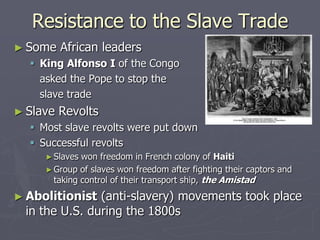
  • #39 Other forms of resistance – moving villages, creating defenses, redeeming (buying back) family members, war, and mutiny
  • #40 Has anyone seen the movie “Amazing Grace”? What is it about?